


The Palace of Las Dueñas
It is one of the most representative buildings of palace-houses Of medieval origin in the city, they were later adorned with Renaissance decoration. This is one of the must-see attractions in Seville, especially in spring!

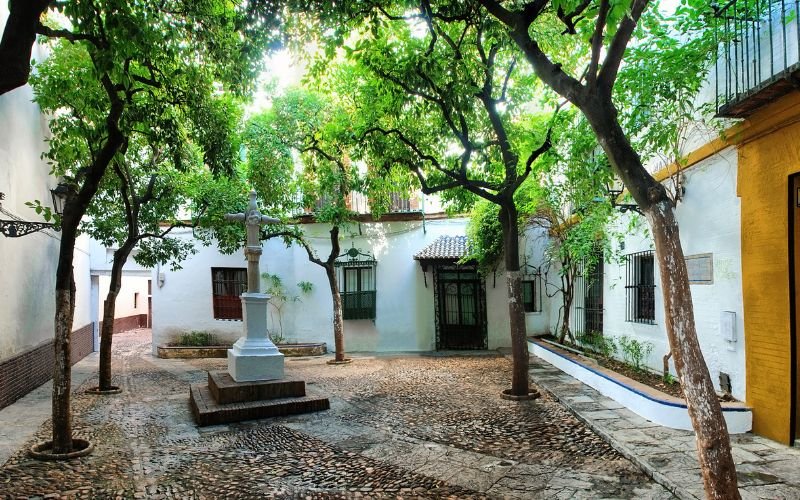
Lemon Tree Courtyard.
The neighborhood
It is located in a around Unique, the historic northern quarter of Seville. A less touristy area, but certainly not lacking in interest. Right next to the traditional shopping district, the Bell, points such as the are found Church of the Annunciation, the crypt of illustrious citizens of Seville and Mushrooms. This palace is located just a ten-minute walk from this meeting place for locals and visitors.

The Duke of Alba with our official guide.
Visit top in Seville
Both for its historical, architectural, and artistic value, as well as for the importance of its movable assets, it is one of the most visited monuments from Seville.
Get ready to enjoy a wonderful tour through its gardens, halls, and courtyards filled with art and history. Places never before shown to the public until March 2016 because they are, even today, the private residence of the current Duke of Alba.

Sculpture and ceramic plaque in the Lemon Tree Courtyard.
Where does its name come from?
The name of the Palace comes from the vanished Cistercian convent of Las Dueñas. This building was located in the peripheral area (of Roman Seville, but within the walled extension made by Ibn Yusf in the 11th-12th century) and was destroyed in 1868.

Main staircase.
Their story
This place, after becoming a plot of land with houses belonging to different owners and their corresponding orchards, passed into the hands of the Pineda, who consolidated the union of these houses. They created a unique palace in the Gothic-Mudejar and Renaissance styles.
She was an illustrious lady, Doña Catalina de Ribera, who acquired it from the Pineda family at the end of the 15th century. Important restoration and expansion works were undertaken, under the direction of the Italian architect Benvenuto Tortello, master builder of the city in the 16th century.
In the 17th century, Antonia de Ribera married the sixth Duke of Alba, Therefore, the palace-house formed part of the legacy of this great noble dynasty.

Detail of the gardens.
The Duchess of Alba
The Palace of the Dueñas is the official residence of the Duke of Alba in the city and was the favorite residence of Doña Cayetana, the 18th Duchess of Alba. She dedicated much of her time to enjoying her home in Seville.
The most recent event at the Palace was the Duchess's third marriage to Alfonso Díaz in the palace chapel in 2011.
Three years later, she passed away in the same palace surrounded by Alfonso and her six children, at the age of 88.
His eldest son, Carlos Fitz-James Stuart y Martínez de Irujo, He inherited the title of Duke of Alba. He wanted to repay the affection and love shown to his mother by the people of Seville and open his house to the public.

Details of family life.
One house, one life
It is one of the most beautiful palaces in the city of Seville. It dates from the 15th century, with spacious private gardens mentioned in the work of the famous poet Antonio Machado. These lines are familiar to every Sevillian: “My childhood is memories of a Seville patio, and a bright orchard where the lemon tree ripens.”
What is extraordinary about this museum space is the intensely personal aspectYou can see family photographs, personal letters, drawings, … You can feel the sense of humor of this great lady of the Spanish nobility.
The Palace of the Dueñas has a large art collection Composed of paintings, sculptures, furniture, porcelain, … Works by Mariano Benlliure, José de Ribera The Spanish One either Luca Giordano They decorate its walls and rooms. However, the most special feature will be the tapestry collection. It boasts a masterpiece of this art form: The loves of Mercury and Herse, of Willem de Pannemaker, unique in the world.
Of course, as a palace, it has large rooms with elegant furniture, But it's full of color and ethnic touches in some more personal places. Sèvres porcelain and figures of lesser artistic value are combined in it. Best of all, nothing has changed In the palace, everything is exactly as the Duchess left it, and that makes it special.

Tablao flamenco de la Duquesa.
An Andalusian house
The palace-house is designed in the typical Andalusian style, with additional rooms that open onto a grand courtyard.
In many ways, Las Dueñas is similar to the Pilate's House, It dates from the same period and was acquired by the same family, the Pinedas. Both have Mudéjar arches, elaborate coffered ceilings, fabulous ceramic tiles, and beautiful gardens.
At Las Dueñas, you will enter through the doors of a typical country house And, little by little, you will arrive at the opulent palace.

Balconies on the facade hidden in the bougainvillea.
A unique style
It was the blend of Arab elements, contributed by the great Islamic masters who worked for the Christian kings after the Reconquista. This confluence of styles is what makes its beauty so spectacular. It is a unique style in the world that you will only find on the Iberian Peninsula.

Detail of the main courtyard.
An oasis in the city
It's a cliché, but as soon as you step through the gate, you can feel an immense peace. It's easy to see why the Duchess loved this place so much. It's in the city center, close to shops and restaurants and the Gypsy Brotherhood Church, her favorite. Even so, it's a calm oasis.

Virgin of the Ancient.
The Palace and its wonders
After crossing the first courtyard, we will walk to the stables. The Duchess was a great horsewoman; we will be able to see photographs of her riding.
From the stables, we will arrive at the Lemon Tree Courtyard, I live on in the memory of Antonio Machado. This is a place to marvel at, to admire the lemon trees, orange trees, grapefruit trees, geraniums, and rose bushes. The Sevillian patio provides coolness on long summer afternoons.
Once in the Main Courtyard, We admire the mix of architectural styles along with the numerous hand-painted flowerpots, vases, and other decorative elements. Our favorite spot in this grand palace.
In the indoor rooms We will highlight the Gypsy Room, the Square Room, the Antechapel, the Chapel, the Summer Dining Room, the Tablao (stage area), and the Library. Each of these spaces has a particular interest. Never losing sight of the Duchess of Alba's distinctive style. She imprinted her personality and way of life on every corner of her house.

Ballroom.
Visit the Palace of Las Dueñas
If you'd like to explore this house steeped in history and not miss a single detail, we encourage you to book a tour. guided tour with us. From Culturea Experience We offer tours of this gem of the city. Discover its secrets with our official guide.

Group visiting the Palace of Las Dueñas with our guide.