


If you are one of those lovers of Seville If you already know the most typical tourist spots and want to get off the beaten path, I propose a great plan to spend a morning.
In the nearby Sevillian town of Santiponce lies a hidden gem: the Monastery of San Isidoro del Campo. Their guided tour is well worth it.
The Monastery of San Isidoro del Campo is one of the main monuments of Gothic-Mudejar from the province of Seville. This style developed in the Sevillian and Cadiz territories in the last decades of the 13th century and extended throughout the Late Middle Ages.
We will begin our Guided tour of the Monastery of San Isidoro del Campo talking about the city where it was founded.

Cloister mural painting.
Santiponce and its treasures
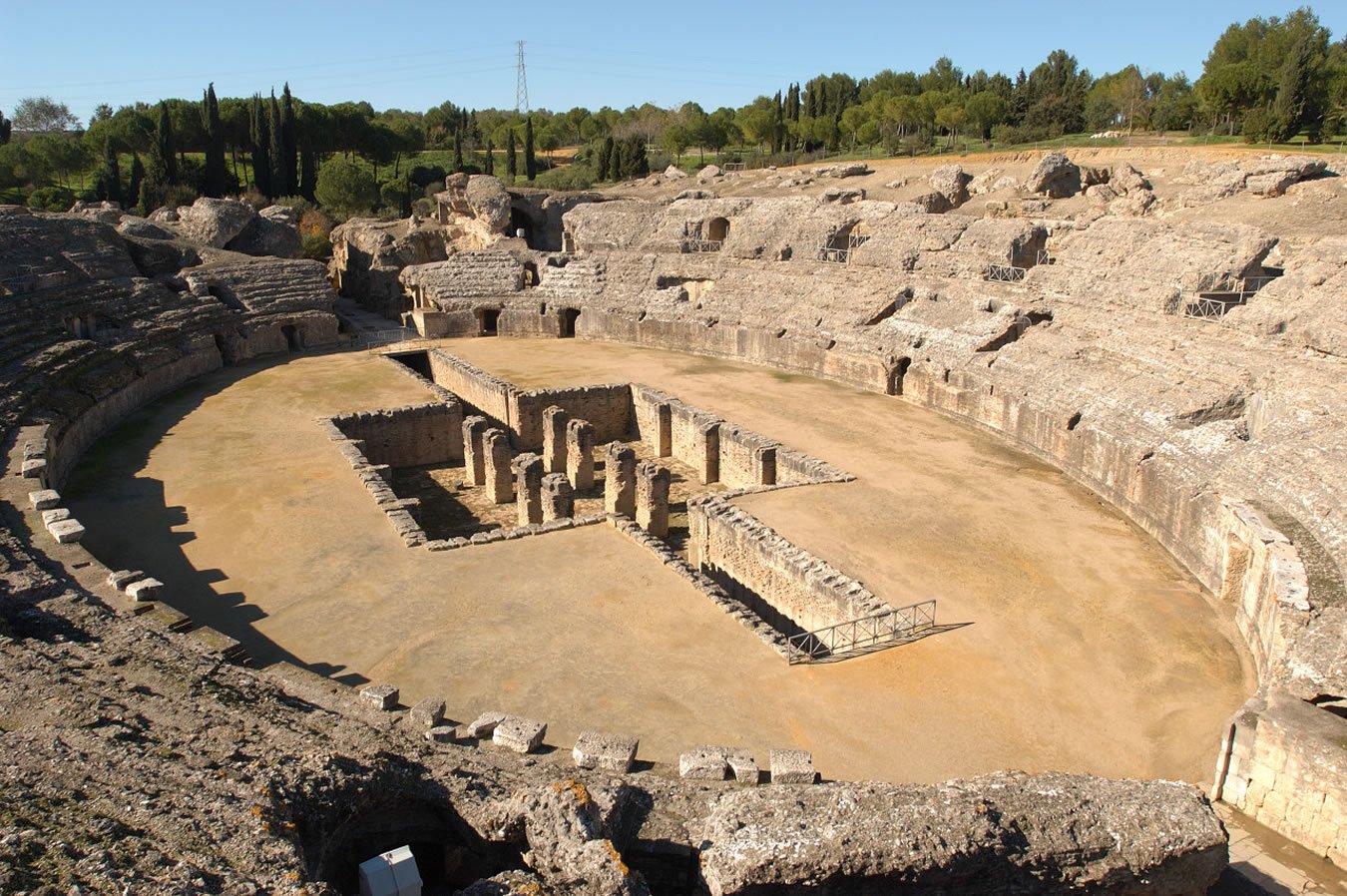
This magnificent monastery is located in Santiponce.This town, located a few kilometers from the city of Seville, is essentially known for the equally magnificent ruins of the Roman city of Italic.

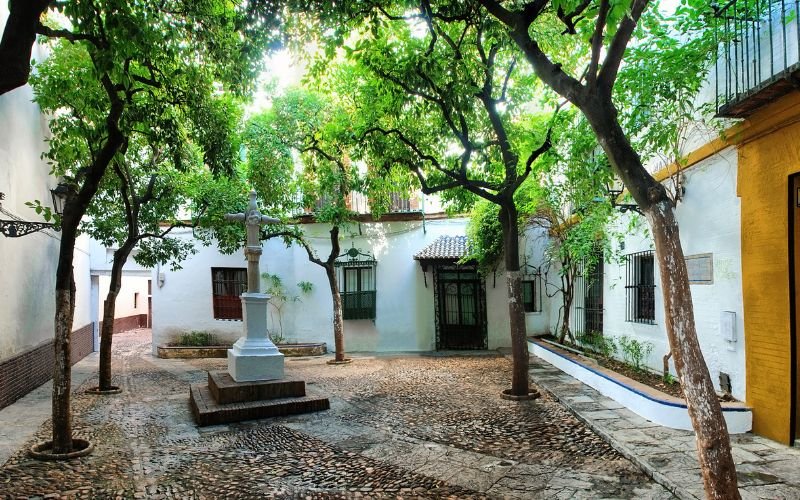
Entrance square to the Monastery.
The Monastery and its foundation
San Isidoro del Campo was founded in 1298 by the celebrated Don Alonso Pérez de Guzmán, historically known as “Guzmán el Bueno”. As is well known, Guzmán el Bueno preferred the death of his imprisoned son to surrendering the city of Tarifa, whose defense had been entrusted to him by King Sancho IV.
The location chosen for this foundation was not accidental; it was built on the site of a Visigothic church where it was thought that the great saint of Hispano-Gothic Christianity had been buried. Saint Isidore of Seville.
It must be remembered that the body of Saint Isidore It was given by the king of the Sevillian taifa Almotahdi to Fernando I, king of León, in the 11th century (year 1063) to be buried in the collegiate church of San Isidoro de León (this church was dedicated to Saint John the Baptist and precisely changed its dedication upon receiving these relics)
This foundation The arrangements were made so that Alonso Pérez de Guzmán and his wife, María Alonso Coronel, could be buried in their church. Interestingly, not only were other people outside the family excluded, but even their own descendants.

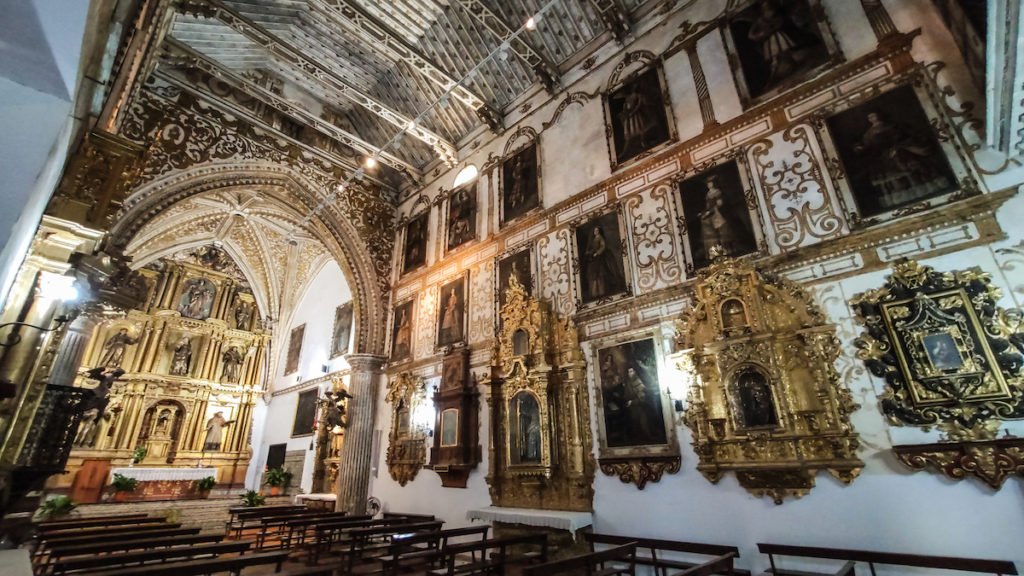
Altarpiece of the old parish church.
The communities that inhabited it
Since its founding, it has been under the spiritual and temporal administration of different religious orders, Cistercians, Hieronymite hermits, and the Order of Saint Jerome. All of them have left their mark on both the construction and decoration of the site.
The first community of monks that occupied and ran San Isidoro del Campo were Cistercians. Although later, in 1432, by order of the Duke of Niebla, the monastery was handed over to the Hieronymite hermits.

Detail of mural painting San Lorenzo, Patio de los Evangelistas.
Construction of the Monastery
The Monastery of San Isidoro del Campo was built in the first decades of 14th century following the guidelines of Sevillian Gothic Mudejar derived from Alfonsine architecture, where the forms of early Gothic are combined with some elements of Almohad origin.

Detail of mural painting.
The churches twins
At this first moment, a single-nave church. The original apse, following the guidelines of this type of architecture, is polygonal, with sharp, slashed windows within deep blind pointed arches and all the eaves topped by a crown of crenellations.
In this sense, and although it may be somewhat surprising, it seems that the existence of crenellated parapets on medieval churches (Romanesque, Gothic, and Mudéjar). As Professor Isidro Bango Torviso of the Autonomous University of Madrid points out, churches, due to their robust construction, also served as defensive structures in times of crisis and were often fortified with battlements. However, these were largely removed starting in the Renaissance. Two notable examples of crenellated churches outside of Andalusia are the cathedrals of Sigüenza and Portomarín. We mention this because it is one of the most defining characteristics of Christian Reconquista architecture in Andalusia.
A few years later, and in the same style, a new church A similar one was attached to the first by order of Guzmán el Bueno's son, Don Juan Alonso. He wanted to be buried in it and respect his father's wish that no one be buried in the first one.
Both churches, besides being similar, share the characteristic of being connected by a large archway pierced in the side wall. This is why they are called the twin churches.

Monastic church.
Monastery Outbuildings
From its medieval period, in addition to the churches, the Monastery of San Isidoro del Campo preserves the refectory, the sacristy, the cloister (call of the Dead) and the chapter house. The new orders that governed the monastery brought new structures and enriched it artistically and architecturally. Among these new additions, the following stand out: Cloister of the Evangelists (especially its Mudéjar and Renaissance paintings).

Mural.
Artistic works of the Monastery
In the two churches and other parts of the monastery there are interesting medieval religious images and tombs, but the most artistically valuable thing is the Main Altarpiece which was sculpted by Juan Martínez Montañés in 1613 for the first church.

Refectory.
Subsequent reforms
In 1432 the Hieronymite hermits of Friar Lope de Olmedo They replaced the Cistercians and carried out a profound reform in the Monastery, which was reflected in the concept of monastic life and substantially in the decoration.
In the mid-16th century, a reformist religious movement emerged in Seville, in which the friars of this monastery participated. This led to the imprisonment of several monks and the flight of others from Spain, among them Casiodoro de Reina, author of the first translation of the Bible into Castilian Spanish, known as the Bear Bible. Following these events, Philip II ordered the merger of the congregation with the Hieronymite Order.

Cloister.
What will we see at the Monastery of San Isidoro
In this unique fortress monastery, with its double church, the Gothic style with clear influences of Languedoc and Mudéjar, in which the Almohad tradition.
In contrast to Cistercian austerity, the Hieronymite monastery is decorated with mural paintings which possibly make up one of the most remarkable groups in all of Spain.

Altarpiece of the Burial of Christ in the Sacristy.
The Monastery was expanded and enriching itself over the centuries. It came to include a tower, a bell gable, five cloisters, and, alongside the monastic buildings, the procurator's office, the guesthouse, and the agricultural facilities typical of these institutions that aimed to be self-sufficient. The medieval core—churches, refectory, sacristy, chapter house, etc.—is arranged around the Cloister of the Dead.
During the Baroque period, this medieval core was transformed with altarpieces (the two on public display by Martínez Montañés stand out, as we have mentioned previously), choir stalls, new mural paintings and plaster vaults.

Virgin and Child attributed to Mercadante of Brittany.
The power of religious orders
Its properties They were very numerous and included the population of Santiponce, originally located on the banks of the Guadalquivir until it was destroyed by a flood in 1603. This event caused the population to move to the ruins of Italica, which led to the current settlement.

Cloister Gallery.
Tips for visiting the Monastery of San Isidoro del Campo
We advise you Book your guided tour of the Monastery of San Isidoro del Campo With an official Seville Tourist Guide, as group tours are not offered inside. This way, you won't miss a single detail of this magnificent place, which boasts countless hidden gems.
The guided tour usually lasts one hour.

Guided tour of the San Isidoro del Campo Monastery.
Another option would be to spend a whole morning or afternoon in the town of Santiponce. I recommend that you do the following beforehand: guided tour of Italica, The ancient Roman city is a short walk from the Monastery, or you can travel there by car. To end the morning, you can do the Guided tour of the Monastery and finish with a soft drink and some lids in one of the most typical bars of this beautiful town in Seville.

Guided tour of the Roman city of Italica, Santiponce.
A fantastic plan for those who already know every corner of Seville and want to learn a little more about the extensive history of its province!

Cloister.