


The Cathedral of Seville
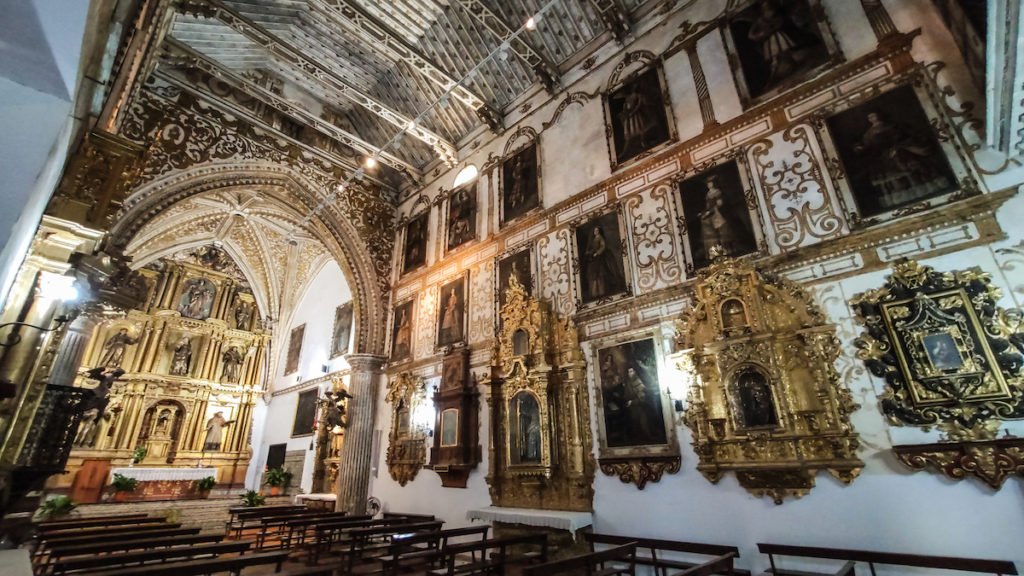
Seville Cathedral possesses one of the richest preserved artistic treasures. It is considered as one of the best art galleries in Spain. A large part of the paintings are works of the highest quality and its updated inventory comprises eight hundred and thirty-three records.
This treasure has been formed over the centuries This was a consequence of the Cathedral Chapter's desire to enrich its cathedral and the eagerness of many of its canons who commissioned paintings to adorn altarpieces and chapels. Similarly, the leading Sevillian families who chose the cathedral as their burial place decorated its chapels with paintings, as did those who bequeathed part of their collections in their wills to be displayed within its walls. Thus, from the 15th to the 19th centuries, The history of painting is extensively represented in Seville Cathedral..

Next, we made a small selection from that large quantity of art jewels which are housed in Seville Cathedral, to analyze them together with their creators. We hope you enjoy it!
-
The Adoration of the Magi, Alejo Fernández
The artist
Alejo Fernández was a painter of the Spanish Renaissance, A renowned and prominent member of the Sevillian school of painting, he received Flemish training and worked between Córdoba and Seville. Born in 1475, his origins are uncertain, although he is attributed a German origin in the Seville Cathedral's account book.
Trained in the Hispanic-Flemish style, He modified it thanks to his knowledge of Italian Renaissance painting, especially from the northern schools, such as Lombardy and Umbria. To this he added the study of prints circulating in Spain, especially German ones, such as those by Martin Schongauer.
His style It marks an entire era of Sevillian painting His work represents a transition to the High Renaissance, although due to its late chronology, the final years of his career coincide with the influences of Mannerism, and especially of Italian Raphaelism in Spanish painting, which in Seville would give way to the style brought by Pedro Campaña. The master's personality is sometimes confused with that of his collaborators and imitators.

His work
In The Adoration of the Kings We see clear Renaissance influences in the treatment of the subject matter, the use of architecture to give depth; in this panel, this is streamlined in favor of the landscape backgrounds and provides a setting for the represented moment, in an anachronistic way.
The composition, of evident flamenco-like taste, It is also somewhat eclectic. The Virgin and Child has a distinctly Dirck Bouts-like appearance, while the rest points more to the Master of 1518 (probably Jan van Doornicke) or to Isembrandt himself.
On the other hand, the architectural ruins open up to wide landscapes of stiff mountains very much in the Umbrian aesthetic, where some very funny camels descend, with necks between swan and giraffe, which highlight the lack of objectivity of these artists of the early 16th century.
This work is located in the Sacristy of the Chalices and dates from between 1508 and 1512.
Even more…
If you'd like to learn more about Alejo Fernández, be sure to visit the Royal Alcázar. There you'll find his most popular work: La Virgin of the Navigators (1531-1536). Painted for the altarpiece of the Chapel of the Casa de Contratación in Seville.
1. The Descent from the Cross, Pedro Campaña
The artist
Pedro de Campaña (1503 – 1580) was a Flemish painter of the Spanish Renaissance, who worked in Seville. His name was Pieter Kempeneer, Castilianized on the occasion of his Hispanic stay.
Born in Brussels in 1503, he belonged to a family of artists and humanists. After beginning his studies in his country traveled to ItalyHe lived in Bologna, Venice, and Rome, where he came into contact with important painters of Roman Mannerism. He also worked and settled in Seville before returning to his homeland to work at the Brussels tapestry factory until his death.
Campaign, important representative of European Mannerism, possessed a great imaginative power and special talent for composing His paintings (his landscapes and architectural backgrounds are particularly noteworthy) brought about a complete renewal for the painters of Seville. Pacheco considered him the patriarch of the 16th-century Sevillian school.

His work
In this work, the figures are inserted into a pyramidal structure. The lower area is dominated by the Virgin Mary, with her hands clasped and her expressive eyes fixed on the lifeless body of her Son. Beside her we find Mary Magdalene with the jar of cosmetics, while behind her stand the holy women, one consoling Mary and the other gazing at the Savior. The solemn figure of Christ The composition is dominated by the image of Christ being taken down from the Cross by the holy men who, having climbed ladders, proceed to lower the dead body. A self-absorbed figure Saint John He holds Jesus' feet.
The scene takes place in a landscape environment, Illuminated in the distance but flooded with contrasts of light and shadow in the foreground, where the action unfolds. The movement of the figures and the expressions on their faces characterize the whole, creating a scene charged with monumentality and drama.
Even more…
You will find works of Pedro de Campaña in the Museum of Fine Arts of Seville, in the Church of San Isidoro in Seville, in the Cathedral of Cordoba, in the Church of San Bartolomé in Carmona, …
2. Mary Magdalene as Melancholy, Artemisia Gentileschi
The artist
Artemisia Lomi Gentileschi was a Italian Baroque painter, A representative of Caravaggism, his artistic training began in the workshop of his father, the Tuscan painter Orazio Gentileschi, one of the great exponents of Caravaggio's Roman school. He explored historical and religious themes in his paintings. His portraits of female figures such as Lucretia, Bathsheba, Judith, and Cleopatra were particularly famous, and have been interpreted as having been interpreted in various ways. feminist traits.
It was the first woman in becoming member of the Accademia di Arte del Design He was from Florence and had an international clientele. He worked under the patronage of Cosimo II de' Medici. He worked in Rome, Florence, and London under the patronage of Charles I of England.

His work
Artemisia Gentileschi, She was raped at 18 by her teacher and her father's friend, and was therefore questioned, humiliated, and scorned… It is understandable that the Baroque painter saw in Mary Magdalene A role model. One of the most important disciples of Jesus Christ, who was even a symbol of a sinful woman.
The figure of Mary Magdalene She was never of interest to a patriarchal institution like the Church, but Artemisia depicted her as a strong woman in several of her canvases., Jesus' right hand, either empowered or looking at us melancholically after suffering all kinds of humiliations as she appears in this painting.
Even more…
You will be able to find More works by Artemisia Gentileschi in the Uffizi Gallery, the Soumaya Museum in Mexico City, or the Virginia Museum of Fine Arts.
3. Pietà of Saint Vincent, Saint Michael and a donor, by Juan Núñez
The artist
Juan Núñez It was a painter in the Hispano-Flemish style Active in Seville at the end of the 15th and beginning of the 16th centuries. Disciple or follower of Juan Sánchez de Castro, the initiator of the Hispano-Flamenco style in Andalusia.
Juan Núñez is a great unknown of the time. It is recorded that in 1480 he signed a document in defense of the Seville painters' guild and that in 1501 he did some painting and gilding work for the brotherhood of San Eloy.

His work
By Juan Núñez only known signed This panel is preserved in the Sacristy of the Chalices of Seville Cathedral. It is a work with a strong Flemish character in its depiction of human figures. Ceán Bermúdez, an enlightened Spanish art critic, referred to it in very complimentary terms for its brilliant color and the detail in the drawing of the dalmatic of Saint Vincent.
It is said that there was also one in the Cathedral of Seville another altarpiece signed by Núñez. According to Ceán's description, it consisted of three panels, with Saint John the Baptist on the central panel and Saint Michael and Saint Raphael on the side panels, "whose wings were like those of a peacock," and it also bore the signature of Nufro Sánchez, carver of the choir of the same cathedral, dated 1475.
4. The Trinity, by Luis Tristán
The artist
Luis Tristán de Escamilla, also known as Luis de Escamilla either Luis Rodríguez Tristán (Toledo, c. 1585-ibid., 1624), was a Spanish Mannerist painter of the Golden Age. Considered the best disciple of El Greco, although it evolved towards a tenebrist naturalism completely opposed to that one.
Luis Tristán worked his entire life in Toledo. He did not stylize his figures as much as El Greco and attempted to temper an already outdated Mannerism with a naturalistic approach to detail and the treatment of materials, an approach that stemmed from... Italian Caravaggism and the echoes of the Counter-Reformation.

His work
In this work, as in almost all of his production, we see how the strong El Greco's imprint It will always remain in his painting, especially in the elongation and instability of their figures. However, his direct knowledge of the Caravaggist experience in Rome, precisely in years when this was at its peak, they also link him to a naturalism evident in some of his works.
Even more…
If you visit Paris, you can find works by our Toledo native in the Louvre Museum, as well as in the Prado Museum of Madrid or in the Museum of Santa Cruz de Toledo.
Visit Seville Cathedral
To fully enjoy this experience, we highly recommend the guided tour of Seville Cathedral guided by an official art expert.
Definitely, One of the best things to do in Seville!