


VISITS TO OSUNA
Book via WhatsApp 665160854 or email: cultureasevilla@gmail.com
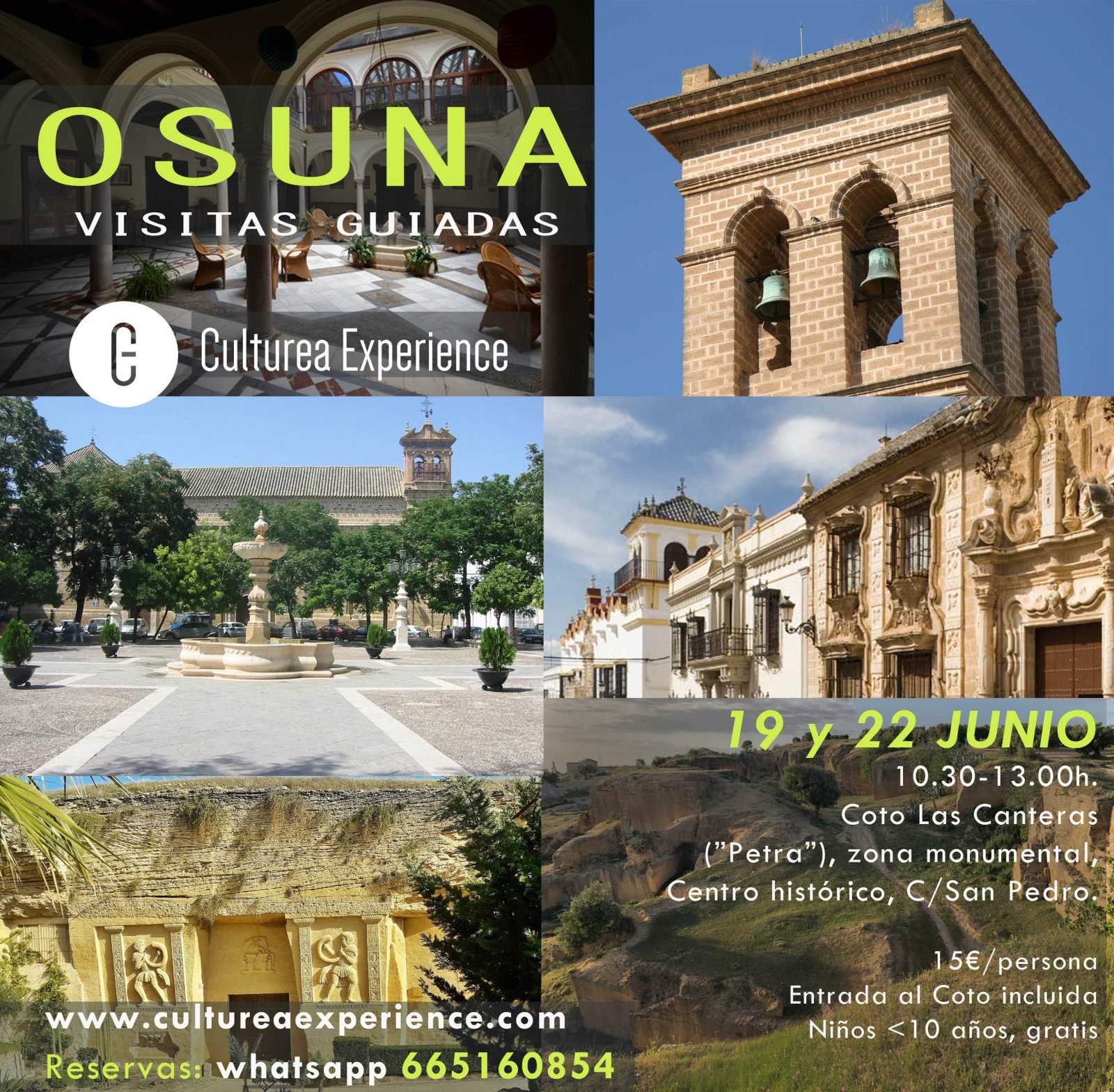
Discover Osuna, the Ducal Town
Welcome to this new article on our blog where we offer our fellow travelers the best information about... guided tour of Osuna and to be able to enjoy a greater knowledge of this monumental Ducal Town.
From here we offer you the possibility of getting closer to an ancient and thousand-year-old city of the Southern Sierra Seville, with an exquisite historical, artistic and cultural heritage, extends its beauty to the rich landscape and natural beauty that it also harbors in the contours of its municipal area.
With these defining characteristics and being heart of Andalusia, Due to its strategic centrality, Osuna is today an ideal destination for numerous travelers who are committed to the richness offered by domestic tourism.
A clear example of Renaissance, A stroll through the streets of Osuna is a journey through its history, allowing you to enjoy its monumental beauty and the architecture of one of the towns that has always been committed to preserving its intrinsic character. to be a Andalusian village.

Situation
Osuna is located southeast of the province of Seville. It is bordered to the North by Écija, to the East by Estepa, to the West by Morón, Marchena and La Puebla de Cazalla, and to the South by El Saucejo, Los Corrales and Martín de la Jara.
It occupies a strategic place within the Andalusian Community, as it is located in the heart of Andalusia.
The municipality of Osuna has an area of 593 km2, therefore being the fourth largest in the province of Seville, representing 4.22% of the provincial area.
Our town is bordered by two distinct regions. On one side, there is the Campiña Sevillana, an almost flat area with clay and limestone soils, which occupies two-thirds of the total area and is dedicated to dryland farming. On the other side, there is the Sierra Sur – foothills of the Betic System – with limestone and gypsum soils, where olive groves and scrubland predominate, and a mountainous topography, sometimes exceeding 500 meters in altitude.
As for the climate, Osuna is characterized by mild winters and short autumns and springs, with an average annual temperature of approximately 18º Celsius, the average maximum being 42.3ºC and the average minimum being 3.6ºC and with rainfall ranging between 550 and 600 l/m2. .

Osuna in history
Prehistory
Our city enters history through the accounts of classical historians and geographers. Strabo, Pliny, and Ptolemy all speak of Romanized Urso. Earlier, Appian and Diodorus describe the presence of troops from Italy who settled in this Turdetani territory to fight the Carthaginians or Viriathus.
However, human settlements in Osuna date back many centuries earlier. There are traces of prehistoric cultures more than a millennium before Christ. The best known were discovered by Engel and Paris in 1903. The Bull and the series of The Reliefs of Osuna They speak of an ancient Iberian civilization, which gave rise to an extraordinary culture where the best Mediterranean traditions from the East and Greece coexisted.
Colonia Genitiva Iulia: the Roman Osuna
The irruption of Rome This will bring about a radical change in all areas. After the Battle of Munda, Urso became the last Pompeian stronghold against Caesar's troops in the bloody Civil War that pitted the two factions vying for hegemony over the Republic against each other. Captured after a siege, it was transformed into Colonia Genetiva Iulia by Caesar, receiving its own colonial law, fragments of which, the Osuna Bronzes, are exceptional legal documents from that period.

The city, included within the Astigitano convent, is transformed into one of the most developed centers of Baetica. The remains of the forum, the theater, and the hypogean necropolis of the Caves testify to its past splendor.
Little remains of the centuries of Visigothic domination. The crisis of the Late Roman Empire gave way to barbarian dynasties that divided the vast territory formerly controlled by Rome into small kingdoms. An increasingly rural world gradually supplanted the old Latin urban civilization.
Muslim rule in Osuna
The landscape will change abruptly with the arrival of Muslims At the beginning of the 8th century, the new lords did not initially alter the administrative and territorial organization of Osuna, which had been in place since the time of Constantine. It would be with the Caliphate, Following the revolt of Ibn Hafsun at the beginning of the 10th century, Ûsuna acquired the status of a cora, ending its previous dependence on Écija. This marked the town's golden age. From a fortified enclave, it transformed into a city. However, the few surviving remains from the period of Islamic rule date from the final stage, under Almohad control. These are remnants of the town's defensive complex: the Water Tower and the walls of the old citadel. Their survival is due to the two centuries of border wars.

The Reconquista in Osuna
Subsequent urban development may help explain the scarcity of remains from that period. In 1240, Ferdinand III The town was taken peacefully. Initially, this change of ruler did not affect the population. Profound transformations occurred after the Mudéjar revolt of 1264. The Muslim inhabitants were expelled, and the fortress was placed in the hands of the Order of Calatrava as an important stronghold, necessary for the defense of a sector of the border region known as the "Moorish Strip.".
The Golden Age of Osuna.
After two centuries of harsh frontier life, during which the town was populated with great difficulty, another significant event occurred in 1464. Osuna entered the sphere of influence of the possessions that Pedro Girón He manages to amass power in Andalusia, governing as the capital of the manorial state that this character manages to consolidate for his son, Alfonso Téllez Girón, 1st Count of Ureña.
Osuna will link his destiny to this family and his peculiar physiognomy will be, to a large extent, a product of the actions of this aristocratic lineage. The Girones They began by implementing an elaborate construction program aimed at providing a symbolic apparatus that reflected the image desired by the lords. As was characteristic of the period, Osuna became a courtly center. At the beginning of the 16th century, they remodeled the old Almohad citadel in a palatial style. The medieval parish church of Santa María was replaced by the magnificent Renaissance building of the Collegiate Church of the Assumption, a work that is completed with the ensemble of the Chapel of the Holy Sepulchre, one of the most interesting examples of the Spanish sixteenth century.

To conclude these artistic companies, The Counts of Ureña—Juan, Pedro, and Juan—hired the finest artisans in Seville at the time. Among those associated with the church are Diego de Riaño, Martín Gaínza, Hernando de Esturmio, Roque Balduque, Luis de Morales, Arnao de Vergara, Juan de Zamora, and others. This ornamental display was further enhanced in the 17th century with the donation from Catalina Enríquez de Ribera, consisting of five splendid canvases by José de Ribera, and the carving of Christ of Mercy commissioned by the Hontiveros family from Juan de Mesa.
The monumental panorama of the ducal acropolis is completed by the building of the University and the Hospital of the Incarnation, Both institutions were founded by the 4th Count of Ureña, father of the 1st Duke of Osuna, a title granted by Philip II to the Girón family in 1562. Coinciding with this aristocratic rise, the House of Osuna tended to align itself with the royal court. Its presence in the town became increasingly sporadic. The era of foundations, exemplified by the immense work of Juan Téllez Girón, who transformed the city along religious lines, seemed to have come to an end.
Parallel to this construction process, the city in the first half of 16th century It has surpassed the limits set by the old medieval wall and extends beyond them. The fundamental structure of the urban layout was defined in that century, and the various religious establishments were established: San Francisco, Santo Domingo, San Agustín, La Victoria, El Carmen, Consolación, La Concepción, Santa Clara, San Pedro, El Espíritu Santo, and Santa Catalina. This list would be completed in the 17th century with the Jesuit convent – San Carlos el Real – the Mercedarian convent, the Descalzas Reales convent, and the hermitage of the town's patron saint, San Arcadio.

The Baroque in Osuna.
In it 17th century and especially in the XVIII, During this period, the local nobility and large landowners rose to prominence. They were largely responsible for the Baroque atmosphere that permeated the streets, especially those of San Pedro, Sevilla, and La Huerta. Although some palatial examples and manor houses from the Renaissance period exist, it was the grand 18th-century mansions that set the standard for Osuna's civil architecture. The Cepeda, Torres, Govantes, Rosso, Tamayo, and other families were determined to perpetuate their status and power with ornate stone doorways. The palace of the Marquis of La Gomera is undoubtedly the finest example. Its highly dynamic doorway, articulated in two columned sections, is crowned with the family coat of arms. The mixtilinear profile of its cornice is broken at the corner by the lookout tower that flanks the façade. It is Baroque with all its dramatic theatricality.
The religious establishment also competed in this frenzied decorative race. Perhaps the two best examples are the Cilla of the Seville Cathedral Chapter and the Convent of La Merced. Both buildings are due to the designs of the Ruiz Florindo family, in the last quarter of the XVIII. Imagination runs wild on the facades, especially on the Mercedarian tower. Classical elements are disrupted with a freedom limited only by the possibilities offered by the stone.
The present-day Osuna
Osuna did not suffer the impact of the developmentalism of the sixties of our century. Emigration replaced the factory construction boom, and the town center, though somewhat depopulated, remained largely unchanged. The economy continued to rely on agriculture, and while this imposed harsher living conditions, it at least allowed the heritage, accumulated over centuries and an expression of past grandeur, to survive to the present day for the enjoyment of all who appreciate beauty and art.

To learn more…
If you would like to learn more about the history, culture, and art of this beautiful town in Seville, we invite you to contact us. Culturea Experience and book your guided tour of Osuna for the date and time that best suits you.
cultureasevilla@gmail.com
Phone +34 665 160 854
We'd love to be with you!