


The second largest art gallery in Spain
The Museum of Fine Arts of Seville is considered the second art gallery in Spain, after the Prado Museum in Madrid.
Works that encompass a wide range of artistic styles that you can contemplate and admire in the guided tours of Culturea Experience.
To do this, you can put yourself in contact Contact us via the link below this article or by email: cultureasevilla@gmail.com or phone +34 665 160854.
You will not remain indifferent to beauty of the place and the quality of the treasures it holds within. Not even before our explanations!

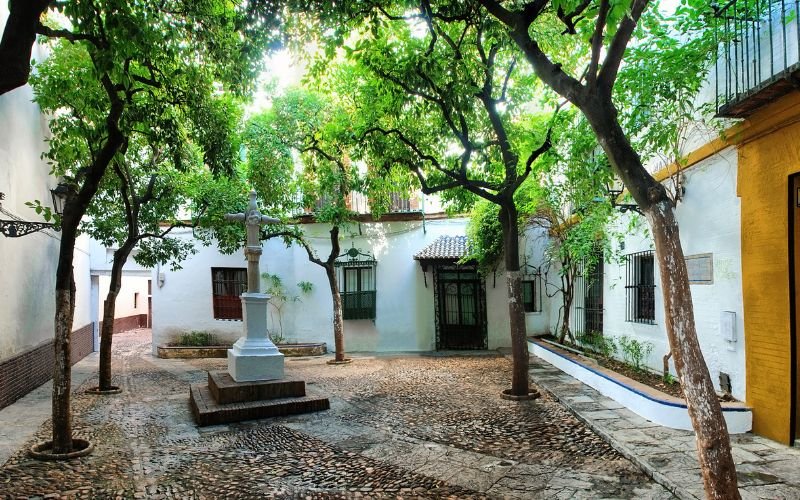
Courtyard of the Boxwood Trees
A special place
Today it is a museum, but it was originally founded as Convent of La Merced, Calzada de la Asunción in the 13th century, during the reign of Ferdinand III, the Saint, after conquering the city of Seville from the Arabs in 1248.
The works we see today were once part of that old convent, and the building's original structure is still preserved. The vast majority of the remaining paintings and sculptures come from other convents, churches, and monasteries that were seized by the state and, fortunately, were preserved in this place, which later became a Museum of Paintings.

Building entrance
The building
This magnificent place is structured as the convent it once was, with its courtyards in the manner of cloisters, its rooms, and the peace that can be felt in a place that has been dedicated to worship and meditation.
The museum organizes its spaces around three courtyards and a grand staircase, Its current configuration is due to the transformations carried out at the beginning of the 17th century. Juan de Oviedo y de la Bandera presented the plans for the construction in 1603, which began with the demolition of the old Mudéjar building. The church was completed in 1612, and almost a century and a half later the rest of the structure, resulting in a beautiful example of the Andalusian Mannerism.

Guided tour by Cultura Experience.
What will we see on the guided tour?
During our guided tour of Culturea Experience we will perform a itinerary through all the rooms of the Museum, Starting from its exterior, to contemplate the surroundings, the Mannerist facade of the building, the beautiful tile panels that embellish its entrance and courtyards… to move on to each of its rooms dedicated to different moments in the history of art in our city, with works by renowned local, national and international artists.

Guided tour with a group of friends from Malaga.
The collection
The collection responds to its historical trajectory: Church property seized by the state, donations of private collections formed during the 19th and early 20th centuries, and acquisitions by public administrations in recent decades.
Sevillian painting
The painting of Seville and its history, with particular emphasis on the 17th century, is the main theme of the museum's narrative, although the Museum has a very diverse collection (painting, sculpture, ceramics, goldsmithing, furniture, etc.).

Detail of Murillo's Immaculate Conception
Why the visit with Culturea Experience Is it special?
Our visit to the Museum of Fine Arts is special, unique and magical because we love our work, we like to communicate and reach people.
Throughout the tour, you will be accompanied by our official tour guide, a Fine Arts graduate and professional artist, who will provide insights into the history, artistic periods, artists, and the execution and complexity of the works. She will enrich our visit with her perspectives on artistic techniques, as she has firsthand knowledge of them all. She is someone who lives and breathes the creative process, just like the great artists we will encounter, even though they are from another era.

Our guide and art expert.
Book your visit now:
https://cultureaexperience.com/blog/tour/museo-de-bellas-artes/
Great masters
We want to give you a sneak peek of what our guided tour together will be like with Culturea Experience.
Works by Pedro Millán, Lorenzo de Mercadante y Bretaña, Frank Franken, Martin de Vos, El Greco, and Pietro Torrillani await us Gothic and Renaissance.
Francisco Pacheco, Luis de Vargas, or Alonso Vázquez will serve as examples for us in Mannerism.
Great artists such as Alonso Cano, Diego de Velázquez, Juan de Roelas, Bartolomé Esteban Murillo, Zurbarán, Valdés Leal and sculptors of religious imagery such as Martínez Montañés and Juan de Mena will have a very important place in our visit to the Spanish Baroque.
We will not overlook the great works of European Baroque with José de Ribera, Matia Pretti, …
Romanticism and Costumbrismo It is aptly illustrated by works by Valeriano Bécquer, García Ramos, Villegas Cordero, …
The 20th Century The Museum of Fine Arts in Seville features works by Jiménez Aranda, Gonzalo Bilbao, Sorolla, and Zuloaga, which will delight us.

Our Lady of the Rosary. Christopher of Augusta.
Itinerary
Art in the Middle Ages
The room of Gothic It delights us with sculptural and pictorial works that were part of those imposing constructions such as Gothic cathedrals, an art linked to religiosity and that sought to get closer to the divine.
Works are on display from Spanish Gothic and the beginning of the Sevillian School.
In sculpture The work of Lorenzo Mercadante de Bretaña and Pedro Millán stands out, and in paint those of artists from the circle of Juan Sánchez de Castro.
We'll talk about that and much more…

Saint Anthony Abbot and Saint Christopher, anonymous Sevillian.
Renaissance Art
Great artists and great works follow one another in the room designated for Renaissance Art. We will discuss the important changes that were taking place in humanity at that time and how our city, Seville, became the capital of the world.
The arrival of works and artists Italians, like Torrigiano, and Flemish artists, like Alejo Fernández, represent the introduction of the Renaissance in Seville.
In this leap in time we will be able to see works by El Greco and Lucas Cranach. The interesting anatomical study of El Greco stands out in sculpture. Saint Jerome by Pietro Torrigiano.

Saint Jerome Penitent, Pietro Torrigiano.
Mannerist Art
The last vestiges of Renaissance art gave rise to a transition period with Baroque Art. This room displays the work of painters who worked in Seville in the last third of the 16th century.
Part of it is on display the series of paintings intended for the Main Cloister of the Convent of the Merced Calzada de la Asunción, current Museum, painted by Alonso Vázquez and Francisco Pacheco.

Mystical Marriage of St. Agnes, Pacheco.
Naturalism
The beginnings of Naturalism in Sevillian painting are showcased, featuring artists such as Francisco Pacheco and his disciples Diego Velázquez and Alonso Cano. The work of Juan de Roelas represents a shift towards a more popular expressiveness, embracing feeling, immediacy, and anecdotes.

Portrait of Don Cristóbal Suárez de Ribera. Velázquez.
Murillo and the Sevillian School of the Baroque
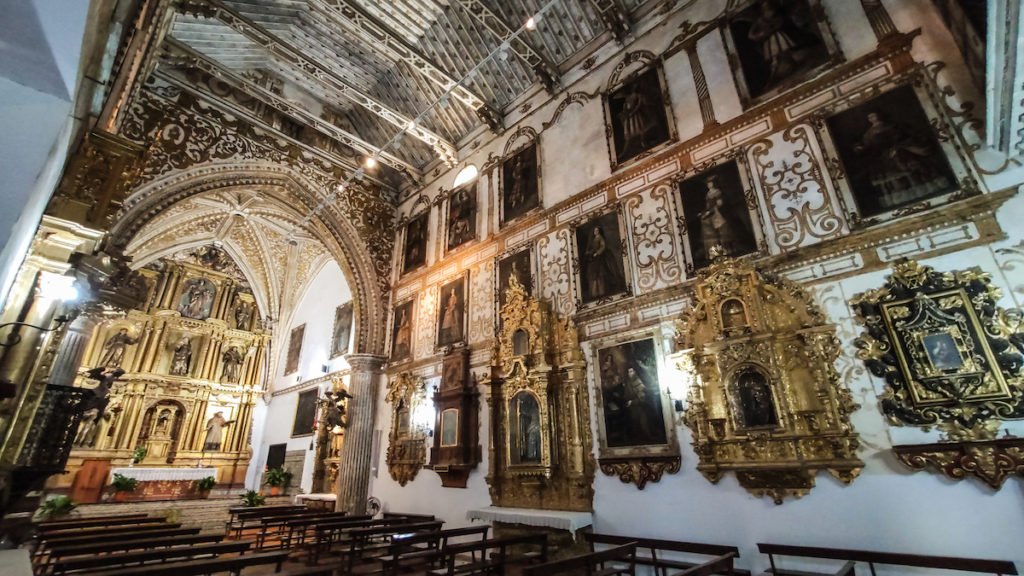
Room V, old church of the Convent, It serves as a grand stage for showcasing the core of the Sevillian School of painting of the 17th century. Starting from Mannerist formulas and an incipient naturalism, which begins with Roelas, it evolves until reaching Murillo, the greatest exponent of the Sevillian Baroque.

Immaculate Conception, Colossal, Murillo.
Alonso Vázquez and Juan de Roelas begin to create large paintings for altarpieces. Herrera the Elder, Zurbarán and Juan del Castillo continued into the second third of the century.
The period culminates with the Murillo paintings for the Capuchin Convent, among which is the famous Virgin of the Napkin.

Virgin of the Napkin. Murillo.
The Spanish and Sevillian Baroque
This gallery displays a selection of Sevillian and Madrid Baroque paintings, highlighting the series of martyred saints from Zurbarán's workshop.
European Baroque painting
Within Baroque art, we will describe several artistic trends, such as tenebrist naturalism and Baroque realism. We will highlight the works of international artists, including Italian, Flemish, and especially those of the Seville Baroque School. This will always be framed within a historical context that will situate us in the complex era in which these great masters lived.

Christ resurrected in the Upper Room. Mattia Preti.
Sevillian painting of the 18th century. Goya.
This period follows the influence of Murillo and Valdés Leal, along with an openness to European trends. The room is completed with a portrait by Francisco de Goya.

Flagellations of Saint Jerome. Valdés Leal.
Romanticism and Costumbrismo
There was a tendency, well into the 19th century, to to elevate the exotic, Different and intoxicating from other distant cultures. Artists and writers sought inspiration in the most remote places and also in Seville…
The walls of this room show the evolution from the Romantic costumbrismo to Realism.
The work of García Ramos, José Villegas and stands out the Cigar Makers by Gonzalo Bilbao.

The Cigar Makers. Gonzalo Bilbao
20th-century Sevillian painting
The penultimate room of the Museum is dedicated to the 20th century artists who had their own personality within the national and local overview and that, in a way, they were influenced by the major European trends.
The room showcases Sevillian painters from the early decades, among whom Gonzalo Bilbao and Gustavo Bacarisas stand out.

Seville during the festivities. Gustavo Bacarisas.
20th Century Spanish Painting
Works by various authors such as Zuloaga, Vázquez Díaz and Sorolla are on display.

Type of Ávila. Sorolla.
Book your guided tour
Contact us in the link below these lines and Tell us your preferences Regarding the day, time, the estimated number of people in your group, or whether you are a couple or a solo traveler, please let us know if you would like to complement your visit with any other activities or if you would prefer us to make some suggestions.
Once we have this information, we will proceed to reserve your tickets at the Museum of Fine Arts. We will confirm their availability as soon as possible. Once we have finalized the above details and confirmed your reservation, we will explain how to pay for the service and thus complete the booking. booking.
If you would like us to advise you on a A specific route designed for you, You can contact us without obligation. We'd be happy to assist you and provide advice. Below you'll find our contact form, phone number, and email address.
Live this experience with us
We will craft the "work" of your visit with the utmost care. We will pay attention to the drawing, the layout, the composition, so that it suits you perfectly. We will add touches of color and care to each of our explanations to reach everyone interested in our visit.
Contact us at the link below.
Visiting the Museum of Fine Arts is a unique experience that we would like to share with you!