


What to see in Seville
Seville is a unique city. You'll be amazed by its majesty, its joy, and its beauty. Every nook, square, and corner is steeped in history and is a unique blend of cultures.
We invite you to discover Seville through the ten most prominent places of the city, emblems and flags of our culture and history.
From Culturea Experience we are betting on a quality tourism, Guided tours led by highly skilled professionals and passionate city lovers. You can contact us before your visit. we will design a specific route According to your tastes and priorities. However, you shouldn't overlook some of these ten top spots. For more information, check out our website at the link below.

View of the Guadalquivir River.
1. The jewel in the crown: the Royal Alcázar
For a thousand years, the kings who ruled our territory, whether Hispania, Al-Andalus, or Spain, were completely enraptured by this place, and it's no wonder…
The Royal Alcázar of Seville is the second most visited monument from Andalusia, second only to the Alhambra in Granada, and, after our visit, you will understand why.
In this magical place, various periods blend together that They illustrate our extensive history. Arabs, Jews, and Christians decorated its walls to show us that it was a period of great tolerance.
We will find palaces They speak of Almohad art, the Mudéjar, Gothic, and Renaissance periods under the Catholic Monarchs. We will leap through time to be captivated by the beauty of the magnificent plasterwork, the colorful tiles, and the harmony of its courtyards and rooms.

Courtyard of the Maidens, Royal Alcázar.
2. The imposing Cathedral of Saint Mary of the See and the Giralda.
Currently, the Seville Cathedral is one of the landmark temples of Christianity, Visited by tens of thousands of people every year, the Cathedral, now one of the symbols of the Andalusian city, embodies the idea of monumentality that underpinned the Gothic project.
Located in the social, economic and religious heart In Seville, the Cathedral tells us about history, splendor and wealth in a Middle Ages that was gradually moving into the Modern Age.
“Let’s build a cathedral that makes everyone who sees it think we’re crazy.” That was the idea, and that’s still the idea, because Seville Cathedral astonishes its visitors with both its imposing exterior and its magnificent interior. divine dimensions that bring Man closer to the House of God.
The Giralda, which became the main symbol of Seville, The bell tower in the northeast corner of the cathedral was a minaret of the old Almohad mosque, which was renovated in the Christian era.
Imitated by numerous churches throughout Andalusia, the Giralda bell tower Designed in the 16th century by Hernán Ruiz, it adapted perfectly to the Almohad structure of the tower.

Cathedral and Giralda from the Patio de Los Naranjos.
3. The color of the Santa Cruz neighborhood
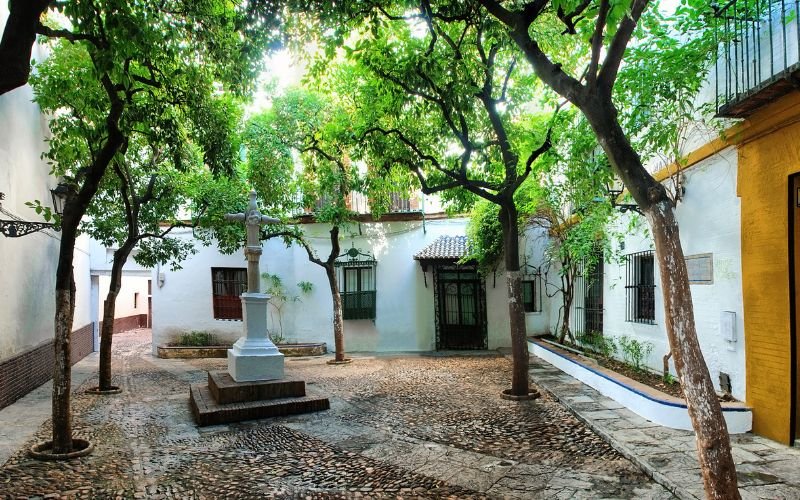
If there is one place that is the image and likeness of Sevillian character It is the Santa Cruz neighborhood. With its tangled alleyways, narrow streets and alleyways, with the vibrant colors of its facades, its rose bushes and geraniums, with the scent of orange blossom from its one hundred and one orange trees, the Santa Cruz neighborhood preserves all the essence which Seville raises as a banner internationally.
Because Santa Cruz is legend and reality, myth and everyday life, a unique combination that speaks to the fact that dreams can come true in certain places in the world like this city.
Many stories were forged within its narrow alleyways over the ages. legends and myths who have achieved worldwide relevance today, because everyone knows what it means to be a "Don Juan"...
The sublime beauty of its corners, They make it possible for all these legends and myths to be enveloped in a magical aura that blends cultures, the Eastern and the Western.

Plaza de Los Venerables, Santa Cruz neighborhood.
4. The great art gallery: Museum of Fine Arts.
The Museum of Fine Arts of Seville is considered the second art gallery in Spain, after the Prado Museum in Madrid.
Works spanning long periods and a wide range of artistic styles, which you can contemplate and admire on our guided tours of Culturea Experience.
We will perform a itinerary through all the rooms of the Museum, Starting from its exterior, to contemplate the surroundings, the Mannerist facade of the building, the beautiful tile panels that embellish its entrance and courtyards… to move on to each of its rooms dedicated to different moments in the history of art in our city, with works by renowned local, national and international artists.
Great works, great masters.
Works The works of Pedro Millán, Lorenzo de Mercadante y Bretaña, Frank Franken, Martin de Vos, El Greco, and Pietro Torrillani await us. Gothic and Renaissance.
Francisco Pacheco, Luis de Vargas, or Alonso Vázquez will serve as examples for us in Mannerism.
Great artists such as Alonso Cano, Diego de Velázquez, Juan de Roelas, Bartolomé Esteban Murillo, Zurbarán, Valdés Leal and sculptors of religious imagery such as Martínez Montañés and Juan de Mena will have a very important place in our visit to the Spanish Baroque.
We will not overlook the great works of European Baroque with José de Ribera, Matia Pretti, …
Romanticism and local customs in Seville are well illustrated by the works of Valeriano Bécquer, García Ramos, Villegas Cordero, …
The 20th century at the Museum of Fine Arts of Seville features works by Jiménez Aranda, Gonzalo Bilbao, Sorolla, Zuloaga, which will delight us.

Facade of the Museum of Fine Arts.
5. Plaza de España and María Luisa Park.
One of the most spectacular places in Seville is its famous Plaza de España, framed by the Maria Luisa Park.
It is a place that speaks of past splendor, specifically from a century ago, of a Seville that welcomed the world into its Ibero-American Exposition of 1929. It was a display of architecture, color, and joy that would bring good times, both personally and economically, to the people of Seville. But this exhibition only served to strengthen the ties with lands that had once been sister nations: the former Spanish colonies.
Visit Plaza de España It's about being immersed in harmony, beauty, light, and color, whether by day or night; it's a place where you let yourself be carried away by the sensations. Our visits to Culturea Experience They intend to let us be invaded by all those feelings, by the greenery of the Maria Luisa Park, by the shine of the glazed ceramic of its panels, by the splendor of its two towers, by the beauty of its whole.
Maria Luisa Park It holds a thousand and one secrets. It is a botanical garden and also a space for culture, specifically literature. Once the private property of a prominent lady, it became one of the largest donations the city ever received.
Lung of Seville, A fresh, light-filled, and vibrant space, the María Luisa Park overwhelms our senses. It's possible to feel as if you're in the Amazon or a Mediterranean forest, thanks to the vast array of species found there, brought from all over the world.

View of the Plaza de España.
6. The charm of the Palace of Las Dueñas
The presence of the famous Duchess of Alba It invades this magnificent 15th-century palace. However, it is much more than this family's private residence. It is a place that speaks of Andalusia Specifically, it's about life in rural Spain, our Arab heritage, the family life of Andalusians…
You will enjoy its wonderful and diverse courtyards, some world-renowned, such as the Lemon Tree Courtyard.
You will admire the art collection composed of six hundred pieces of art: paintings, sculptures, furniture, tapestries, ceramics, period posters along with family mementos of important figures.
Works by Neri de Bicci, José de Ribera, Luca Giordano, among others, in addition to one of the best tapestries in the world, a work from the workshop of Willem de Pannemaker, great Belgian tapestry makers.

Main courtyard of the Palace of Las Dueñas.
7. Costumbrista art in the Bellver Museum
This museum is the result of a collection donated by an art lover, collector, and patron., Mariano Bellver.
Five hundred artistic pieces They are distributed in twelve rooms around the main courtyard.
The collection features works by Gonzalo Bilbao, García Ramos and Jiménez Aranda, but also important sculptures of Martínez Montañés.
The works are mostly by traditional style from the 19th century, although there are also sculptures, porcelain pieces, furniture and clocks.
From the first third of the 19th century, there was an interest in popular culture, both in art and in literature and music, a trend known as Costumbrismo. During the 19th century, this new genre was explored by a large number of painters working in Andalusia, forming a distinct group within the Spanish artistic scene of that time.
The main topics These costumbrista works will feature bandits, muleteers, romances in inns, flamenco festivals, pilgrimages, fairs, bullfighters, gypsies, dancing, …

Sculptures from the Bellver Museum.
8. The Church of San Luis de Los Franceses will surprise you
This church is a unique jewel of the Andalusian Baroque. Located in the northern historic center and away from the hustle and bustle of tourist Seville, it stands out to impress us both for its exterior facade and for everything that its interior entails.
It is a former Jesuit novitiate convent, which included two large courtyards, the reception hall, the Church of San Luis and the domestic chapel.
The Baroque at its finest leaves its mark with artists such as Leonardo de Figueroa, Domingo Martínez and Lucas Valdés.
A large number of Visual games, religious symbolism, Deceptions in perception make this work one of the best examples of Baroque art in Spain.

Detail of the facade of the Church of San Luis de los Franceses.
9. The Convent of Santa Paula, an oasis of peace
Visiting the Convent of Santa Paula is to let yourself be carried away by peace The place itself, and the kindness of its Sisters, makes us realize that there is more to our world than our hectic, stressful lives. Other values permeate its walls and courtyards.
This convent preserves a large art collection donated by María Cristina de La Cruz Arteaga, which consists of paintings, sculptures, ceramics, reliquaries, furniture items, etc.
In its spectacular museum We will see works by Luis de Morales, José Risueño, Nicoluso Pisano, among others.
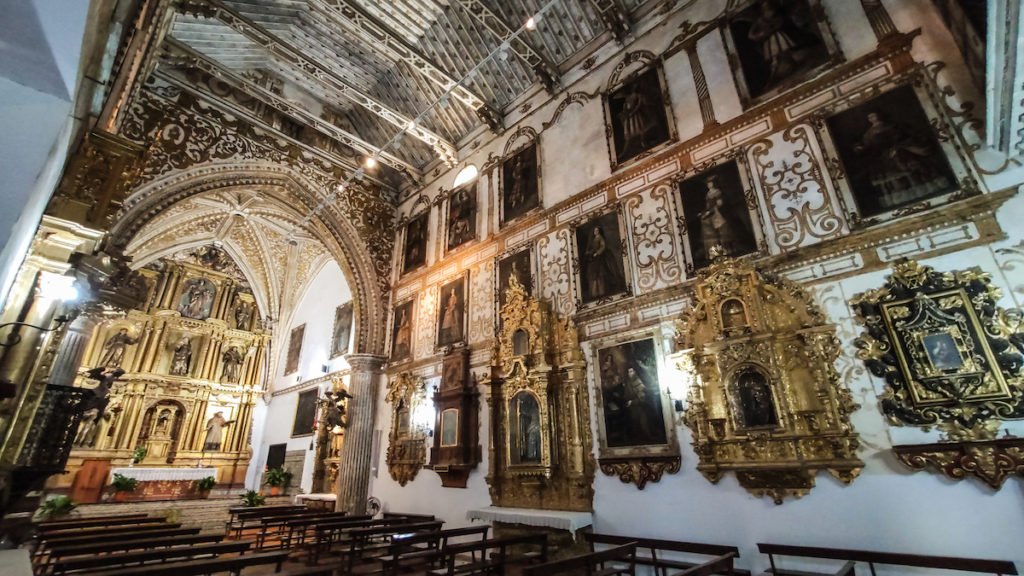
The church This convent is very interesting and unique in the city. It combines Gothic and Mudéjar styles with some early Renaissance elements. We will find architecture by Diego López de Arenas, paintings by Domingo Martínez and Alonso Vázquez, and sculptures by Martínez Montañés, Della Robbia, and Pedro Millán.
Quite a hidden gem in the northern historic center of Seville that you cannot miss.

Church of the Convent.
10. Tradition in Triana and El Arenal
The bullfighting neighborhood from Seville is the Arenal. It is located next to the Guadalquivir River, as the river sands were the center of all port activity for centuries. The neighborhood extends to the Cathedral to the east, the Cristina Gardens to the south, and Reyes Católicos Street to the north.
This neighborhood has inspired hundreds of writers from the Golden Age, such as Cervantes, Lope de Vega, and Quevedo. Furthermore, it has witnessed the great transformation that has taken place in the city.
It is currently also known for having the best restaurants of Seville and leisure venues.
We will find monuments like the Golden Tower, the Maestranza Bullring, the Maestranza Theatre, Las Atarazanas, the Charity Hospital, the Arenal Market, the Carretería Chapel or the Chapel of Our Lady of Solitude.

Facade of the Royal Cavalry Armory of Seville.
The Triana neighborhood
This neighborhood has its own essence, It is said that Triana is a village in itself, not part of the city. Its unique way of understanding life stems from its history, which runs parallel to the city as such, since Triana has always been considered a separate village. This is due to the physical separation created by the Guadalquivir River.
Neighborhood of sailors, flamenco artists and artists, The city is the cradle of Flamenco. In the courtyards and tenement houses, the ancestral echo of bulerías, tangos, and alegrías still resonates.
As Camarón de la Isla would say, Triana has “joy and beauty and grace in its walk, and even your laughter is beautiful compared to others”… That's Triana.
Furthermore, it is the pottery quarter, where ceramic factories are hidden in its narrow streets.
We will find monuments and spectacular places such as the Castle of San Jorge, which was the headquarters of the Inquisition and is now the Triana market; the Triana monument, Calle Betis with its wonderful view of Seville; the Church of Santa Ana or Triana Cathedral, among other places.
If what you want is to take the best tapas, You'll find plenty of bars and restaurants, as well as shops. nightlife on the internationally famous Betis Street.

Detail of a traditional Sevillian patio in Triana.