


Seville It is one of those cities that has a large number of places to visit, each one more beautiful and different than the last.
The capital of Andalusia has a long history and extensive tradition And, in addition, it has the largest old town in Spain and the sixth largest in Europe, after Rome, Naples, Venice, Florence and Genoa.
Seville is currently the third most visited city in Spain, After Madrid and Barcelona, its heritage is enormous, with monuments such as the Cathedral, the Giralda, the Torre del Oro, the Alcázar…
In this article, I encourage you to discover 10 places that don't usually appear in travel guides and that you'll love to visit.

10 places to visit in Seville that are not the typical tourist spots
- Royal Tobacco Factory.
The building's construction began around 1728. It became the headquarters of the first tobacco factory in Europe and the most important industrial building in Spain in the 18th century.
Architecturally, its structure stands out Renaissance references with Herrerian touches, although the influence of the main facade can be seen Baroque style.
The building is surrounded by a moat due to its construction outside the city walls, attached to part of the city wall in that area.
Today, it is the headquarters of the rectorate of the University of Seville and the faculties of Law, Sciences, and Philosophy and Letters. Entry is free and no ticket is required, making it easily accessible and one of the less typical places in Seville.

2. Green street.
This street is located in the San Bartolomé neighborhood. It is a pedestrian street near the parish that bears the same name as the neighborhood.
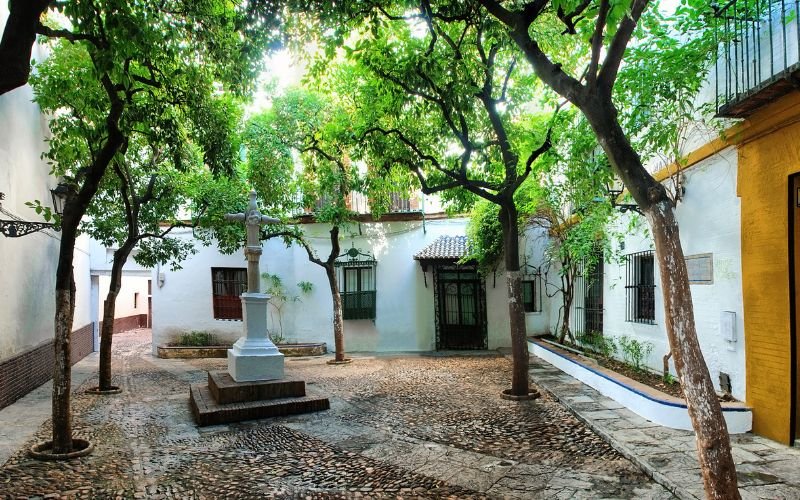
On both sides of Calle Verde, we find low-rise residential buildings. Its most striking feature is the abundance and vibrant color of the vegetation that peeks through the walls of the various houses and the vines that form a canopy. For example, the Patio de la Padilla House, It is one of the oldest houses in Seville, which is now a hotel and can be visited.

3. Devil's Gate.
This wrought iron gate is located on a stately home in the Santa Cruz neighborhood, very close to the Murillo Gardens and the Callejón del Agua (Water Alley). Specifically, it is on the Alfaro Square.
Its origin is unknown. This gate is very unusual; the bars are neither glued nor welded, they remain joined by being intertwined, as if the iron had been made of plasticine or clay and then hardened, something that would be completely unnatural.
This characteristic is what has led to the story that it was forged by the devil himself, becoming the only being that can touch iron in that state without getting burned.
Becoming an emblem of Santa Cruz neighborhood, This gate has little to do with the paranormal: it was made with tongue and groove joints and, moreover, was manufactured in different parts of Spain, Austria, and Italy. Due to the difficulty of its creation, master craftsmen said that "Only the devil could have been its creator.".

4. The Silver Tower
I'm sure you've heard of it. Golden Tower From Seville, but did you know it has a sister? Just a few steps away, at the beginning of Santander Street, you'll find the Torre de la Plata, although it's a bit hidden, right next to the Hospital de la Caridad in the Arenal neighborhood.
The Silver Tower, It is an octagonal tower built in the 13th century and was connected to the Torre del Oro by a section of wall that was demolished in 1821.
In the time of Alfonso X it was also called Tower of the Azacanes (Arabic name given to water carriers who used a horse or a handcart for this purpose).
Next to the Tower there is a parking lot where the Corral de las Herrerías was located in the 17th century.

5. Casa Fabiola.
It's a beautiful historic building which served as a dwelling in the 14th century, during the reign of Alfonso XI.
It is located in the San Bartolomé neighborhood, very close to the Cathedral and the Alcázar.
It's a great example of Sevillian palace house: In the center, a large courtyard features a cloister-like gallery and a main staircase clad in white Italian marble. It boasts hydraulic tile floors, stucco walls, and polychrome wooden coffered ceilings.
It was the birthplace of Cardinal Nicholas Wiseman, author of the novel Fabiola, which gives the house its name.
In 2018, it was established therein the Bellver Museum, To showcase the art collection of Mariano Bellver, a Spanish art collector and patron, who donated his collection to the Seville City Council. We will see more than 500 works of art, among which the following stand out: paint costumbrista Sevillian.

6. Pantheon of illustrious citizens of Seville
Below the central Church of the Annunciation, in its crypt, is found the Pantheon of illustrious citizens. But its current entrance is from the courtyard of the Faculty of Fine Arts.
This is one of the less typical places to visit in Seville. This Pantheon originated as a place to house the funerary remains that came from some of the city's churches after they were damaged by French troops in convents, such as those of Santiago and San Agustín, and from churches that had been seized by the state.
Right here they are the remains of many of Seville's most illustrious citizens, such as Arias Montano (humanist), Fernán Caballero and Mateos Gagos (writers), Alberto Lista (illustrated) or the Bécquer brothers; Gustavo Adolfo Bécquer, the great poet or his brother Valeriano Bécquer who was a painter.

7. Roman Columns on Mármoles Street.
In the 16th century six Roman columns Columns approximately 15 meters tall were found in the San Bartolomé neighborhood. Their exact origin is unknown, but it is believed they belonged to an ancient Roman temple located in that area.
Of the total, two were transferred to the Alameda de Hércules In 1574, Bartolomé Morell erected the first column, which served as the base for the sculptures of Hercules and Julius Caesar, the founders of Seville. The third column fared worse, breaking during its transfer to the Royal Alcázar, the residence of King Pedro I. The remaining columns survived by being embedded in the courtyard of a house until 1885, when the Seville City Council acquired the house and demolished it in 1886.
This is a hidden gem near the Santa Cruz neighborhood and the Cathedral, but it's one of the lesser-known and less typical places to see in Seville.


8. The Shot Tower
The Shot Tower It is another of Seville's lesser-known spots. This tower was part of the old "San Francisco de Paula" factory, popularly known as the "Shotgun Factory.".
This place was a foundry more than the many that existed in our city and was dedicated to the pellet manufacturing in a very particular way: Once the lead was taken up to the tower, it was melted in a furnace and with large ladles it was poured into sieves of different calibers (of shot), the windows let in the air and the current did the rest, due to the effect of gravity the shot fell like rain.
You can currently visit it as «Camera obscura» It allows you to see the city from a height of 45 meters. It projects a live, moving image of what is happening outside at that very moment.

9. Central Post Office Building of Seville.
Located in one of the most famous areas of the Andalusian city, on Avenida de la Constitución, lies this lesser-known and less typical place to visit in Seville. Central Post Office Building It is located directly opposite the "Archivo de Indias" tram stop.
On the occasion of Ibero-American Exposition, The city council granted a plot of land in the old Salt Warehouse to the Ministry of the Interior so that the works of the new Post Office Headquarters could begin.
It was designed by architects Joaquín Otamendi and Luis Lozano and built between 1927 and 1930. It is in the style Art Deco With some Neo-Baroque features, it is considered one of the few examples of this style in the city. It was restored between 1988 and 1992.
His Admission is free. It is still the main post office in Seville.

10. Archaeological site of Cortijo de Miraflores and Huerta de la Albarrana
This archaeological zone of great value It is located in Miraflores Park, in the Pino Montano neighborhood, and is one of the least known and least typical places to see in Seville, a true treasure…
Miraflores Park It is one of the largest in the city, and its origins show evidence of a rural settlement dating back to Roman times. This settlement would have served to supply the city with agricultural products.
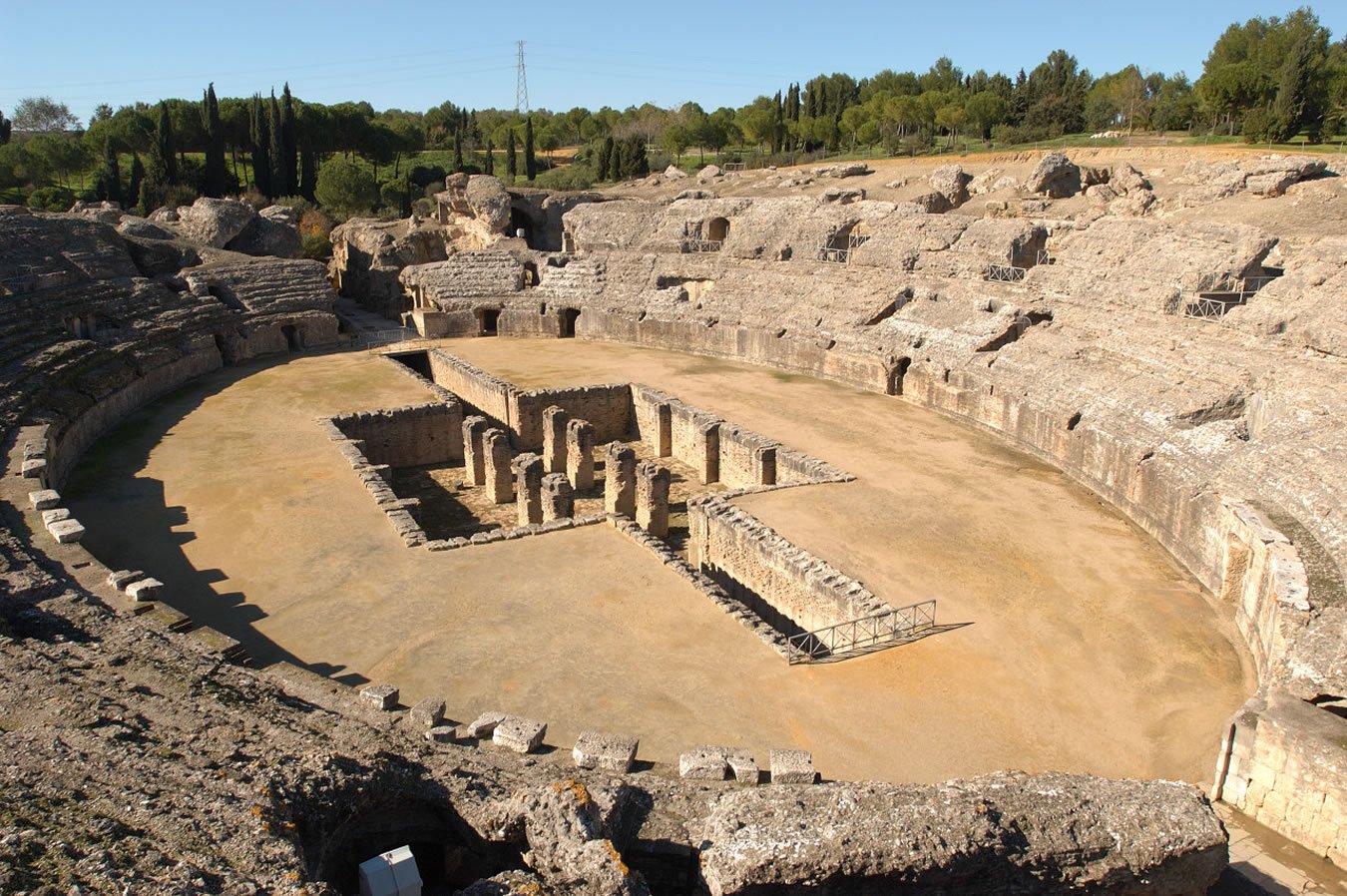
Archaeological studies confirmed that there was a rustic villa from Roman times which extends around the Cortijo de Miraflores and whose origin dates back to the 1st century BC, where they have been found ceramic remains.
This farmhouse preserves a Almohad tower, from the late 12th century or in the same space is preserved 18th century oil mill which remained active and owned by the House of Alba until the end of the 19th century.

If you found this article interesting and would like Learn more From our beautiful city, I encourage you to visit the rest of the articles on our blog, web or join our open or private guided tours for you and your group of friends.
It will be a pleasure to enjoy Seville together!